








India’s IPO Market Raises ₹44,451 Crore in October: Why Mega Issues Are Reshaping Fundraising
Indian mainboard IPOs raised ₹44,451 crore in October 2026, with Jio Platforms accounting for nearly 68% of the total. The figures reveal how large offerings can shape the country’s primary...

Indian mainboard IPOs raised ₹44,451 crore in October 2026, with Jio Platforms accounting for nearly 68% of the total. The figures reveal how large offerings can shape the country’s primary market.
India’s primary market recorded substantial fundraising activity in October 2026, with mainboard initial public offerings raising ₹44,451 crore.
However, the headline figure was heavily influenced by one large offering.
Jio Platforms’ ₹30,188-crore IPO accounted for nearly 68% of the total mainboard fundraising during the month, according to data reported from Prime Database.
The concentration highlights an important feature of India’s IPO market: the total amount raised can rise sharply when a small number of large companies enter the public market.
At the same time, small and medium enterprise (SME) IPO fundraising moved in the opposite direction, declining significantly during October.
How much did Indian companies raise through IPOs?
According to data reported by Business Standard on November 1, 2026:
I
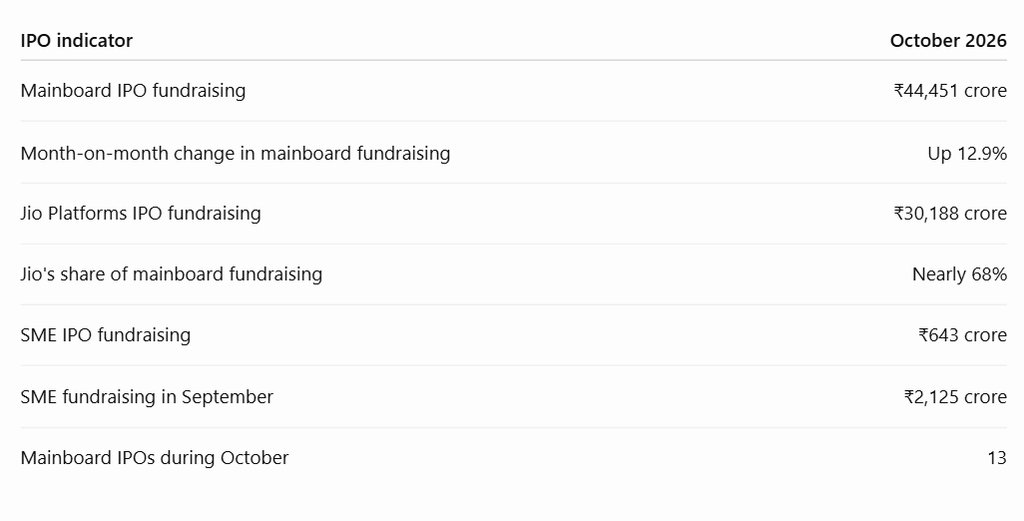
The figures show that the mainboard market remained active, but the fundraising total was concentrated in a large issue.
Why did Jio Platforms have such a large impact?
Jio Platforms’ ₹30,188-crore issue represented a substantial share of the month’s mainboard fundraising.
When a company raises a large amount through an IPO, it can influence aggregate market statistics even if the number of other offerings remains unchanged.
This creates a distinction between the overall fundraising figure and the breadth of participation across companies.
A market raising more money does not necessarily mean that every sector, company or investor segment is experiencing the same level of activity.
Mainboard IPOs versus SME IPOs
India’s primary market includes offerings from larger companies as well as smaller businesses.
Mainboard IPOs are generally associated with companies meeting the listing requirements of the main stock exchanges.
SME IPOs are designed for eligible small and medium enterprises seeking access to public capital markets under the applicable exchange frameworks.
October’s figures showed different fundraising trends across the two segments.
Mainboard IPO fundraising increased 12.9% month-on-month to ₹44,451 crore.
In contrast, SME IPO fundraising fell to ₹643 crore from ₹2,125 crore in September, a decline of approximately 70%.
This difference suggests that the primary market’s headline strength did not extend equally across all company sizes.
How active has India’s IPO market been in 2026?
The same report stated that 109 mainboard issues had raised approximately ₹1.58 trillion during 2026 up to the end of October.
For comparison, mainboard IPOs raised approximately ₹1.76 trillion during the whole of 2025.
The figures indicate that the mainboard market had already mobilised a substantial amount of capital by October.
The SME segment recorded 193 issues during 2026, raising approximately ₹8,629 crore.
These totals demonstrate the role of public offerings as a source of capital for Indian businesses.
Why do companies launch IPOs?
An initial public offering allows an eligible private company to offer shares to public investors and list them on a stock exchange.
Companies may use IPO proceeds for several purposes, including:
- Business expansion.
- Capital expenditure.
- Debt repayment.
- Working capital.
- Acquisitions.
- General corporate purposes.
The exact use of proceeds varies from one issue to another.
Investors should examine the offer document to understand whether an IPO includes a fresh issue, an offer for sale, or a combination of both.
In a fresh issue, the company receives the proceeds from newly issued shares. In an offer for sale, existing shareholders sell their holdings, and the proceeds generally go to those selling shareholders.
What should investors examine before applying for an IPO?
High fundraising figures and market attention do not automatically make an IPO attractive.
Investors should examine several factors before applying.
- Business model
Understand how the company generates revenue, its competitive position and the sustainability of its operations.
- Financial performance
Review revenue, profitability, cash flows, debt and historical financial trends.
- Valuation
Compare the proposed valuation with the company’s fundamentals and relevant listed peers.
- Use of IPO proceeds
Check whether the money is intended for business expansion, debt repayment or existing shareholder exits.
- Risks disclosed in the offer document
Read the risk factors, litigation details, customer concentration and dependence on key suppliers.
- Promoter and shareholder information
Understand the promoter background, existing ownership structure and post-listing shareholding.
- Listing and liquidity risk
An IPO’s listing price is uncertain. Shares can list below the issue price and may remain volatile after listing.
What does the October fundraising data tell us?
October’s figures highlight two important trends.
First, India’s mainboard IPO market raised a substantial amount of capital, bringing the 2026 total close to the previous year’s annual fundraising figure.
Second, the monthly total was heavily influenced by a single large issue, while SME fundraising declined.
For investors, this is a reminder that IPO market headlines should be read alongside issue-level details, valuations and the intended use of proceeds.
Conclusion
India’s mainboard IPO market raised ₹44,451 crore in October 2026, with Jio Platforms accounting for nearly 68% of the total.
The contrast between mainboard and SME fundraising also highlights how differently market segments can perform during the same period.
For investors, the size of an IPO or the amount raised should never replace an assessment of the company’s financial position, valuation and long-term business prospects.
Disclaimer: This article is for informational purposes only and does not constitute investment advice or a recommendation to apply for any IPO. IPO investments carry market, valuation, liquidity and business risks. Read the relevant offer document before making an investment decision.






No Comment! Be the first one.