






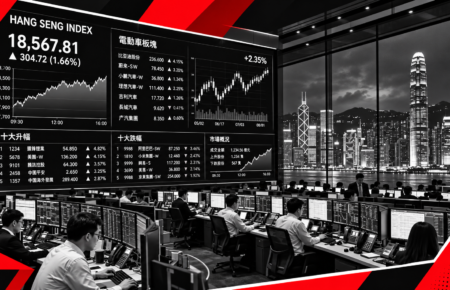
Hang Seng Index Today: Hong Kong Stocks Rise 0.5% Despite Global Technology Sell-Off
Hong Kong’s Hang Seng Index recovered on November 16, gaining 116 points as consumer and banking stocks supported the market. However, technology shares remained under pressure amid concerns...


Hong Kong’s Hang Seng Index recovered on November 16, gaining 116 points as consumer and banking stocks supported the market. However, technology shares remained under pressure amid concerns about global AI investments and semiconductor valuations.
Hong Kong’s stock market ended higher on Monday, November 16, after facing pressure during the previous three trading sessions.
The benchmark Hang Seng Index closed at approximately 23,753 points, gaining 116 points or 0.49% during the session. The recovery came despite weakness across several Asian technology markets, where investors continued to sell semiconductor and artificial intelligence-related stocks.
According to market data reported by RTHK, trading turnover on the Hong Kong main board reached approximately HK$174.11 billion.
The Hang Seng China Enterprises Index also gained around 0.55%, while the technology-focused Hang Seng Tech Index declined approximately 0.3%.
Why Did the Hang Seng Index Rise Today?
The recovery was supported by gains in banking, consumer and financial stocks.
Investors appeared to find opportunities in selected companies following recent market declines. Improved expectations of possible economic support measures from Beijing also helped sentiment.
Among individual stocks, Haidilao gained approximately 5.24%, while Mengniu Dairy advanced 4.38%. Several other consumer-focused companies also recorded gains.
Banking stocks provided additional support to the broader market.
However, the recovery was not uniform. Technology companies continued to face selling pressure, showing that investors remained cautious about expensive growth stocks.
Why Are Technology Stocks Under Pressure?
One of the biggest concerns affecting Asian markets is uncertainty surrounding the global artificial intelligence industry.
Investors are closely watching semiconductor companies and the financial performance of businesses investing heavily in AI infrastructure.
Concerns about future profitability, high investment costs and changing expectations have increased volatility in technology shares.
On Monday, Lenovo Group fell approximately 5.9%, while Semiconductor Manufacturing International Corporation (SMIC) declined around 5%.
The weakness reflected broader concerns affecting technology-heavy markets in Japan, South Korea and Taiwan.
How Is China’s Economy Affecting Hong Kong Markets?
China’s economic performance remains an important factor for Hong Kong equities.
Recent economic figures showed that China’s industrial output grew 4.8% year-on-year in October, while retail sales increased by just 0.4%.
Fixed-asset investment also declined 8.1% during the first ten months of 2026.
These figures indicate that domestic demand and investment activity remain under pressure.
Investors are therefore watching for possible government stimulus measures to support consumption, businesses and economic growth.
What Should Indian Investors Watch?
The Hang Seng Index matters to Indian investors because movements in major Asian markets can influence global risk appetite.
A sharp decline in Hong Kong technology stocks can affect sentiment towards technology and semiconductor companies worldwide.
However, Indian markets do not always follow Hong Kong’s direction. Domestic earnings, foreign investment, interest rates and economic growth also influence the Sensex and Nifty.
Investors should monitor developments in China, global technology earnings and foreign capital movements before drawing conclusions about Indian equities.
The Bottom Line
The Hang Seng Index’s 0.49% recovery on November 16 offered some relief after recent losses. However, weakness in technology shares showed that global investors remained cautious.
The coming sessions will be important as investors assess China’s economic outlook, AI industry valuations and developments across international financial markets.






No Comment! Be the first one.