








Mutual Fund SIP Inflows Hit Record ₹32,490 Crore in September 2026: What the Numbers Reveal
India’s monthly mutual fund SIP contributions reached a record ₹32,490 crore in September 2026. Here’s what the latest AMFI data says about retail investing, equity fund inflows and the...


India’s monthly mutual fund SIP contributions reached a record ₹32,490 crore in September 2026. Here’s what the latest AMFI data says about retail investing, equity fund inflows and the wider mutual fund industry.
India’s mutual fund industry continued to attract substantial money from individual investors in September 2026, with monthly systematic investment plan (SIP) contributions reaching a new record.
According to data released by the Association of Mutual Funds in India (AMFI), SIP contributions stood at ₹32,490 crore in September, marginally higher than ₹32,297 crore in August.
Equity mutual funds also recorded strong inflows during the month. Net inflows into equity-oriented schemes reached approximately ₹38,307 crore, marking an increase of around 31% compared with August.
However, the headline numbers came alongside a decline in the mutual fund industry’s overall assets under management (AUM). Total industry AUM stood at ₹82.64 lakh crore at the end of September, compared with approximately ₹87.08 lakh crore in August.
The data highlights an important distinction: regular investor contributions can remain strong even when the overall value of assets managed by the industry declines.
What are SIP investments?
A systematic investment plan allows an investor to contribute a fixed amount to a mutual fund scheme at regular intervals, usually monthly.
Instead of investing a large sum at once, an investor can spread contributions over time.
SIPs are commonly used to invest in equity, debt and hybrid mutual fund schemes. The amount, frequency and scheme depend on the investor’s financial goals and risk tolerance.
SIPs do not guarantee returns or protect investors from market losses. The value of mutual fund investments can rise or fall depending on the underlying securities and market conditions.
September 2026: Key mutual fund figures
AMFI’s September 2026 data provides a snapshot of the industry’s investment activity.
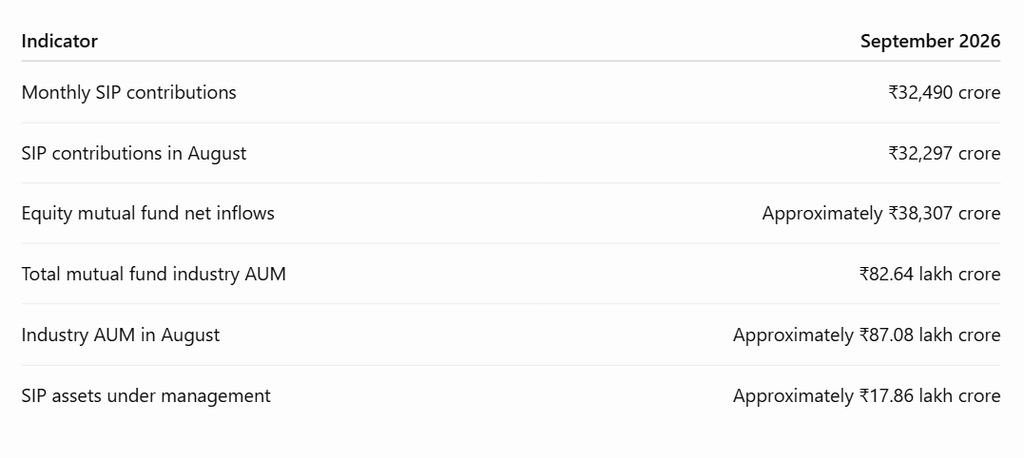
The September SIP contribution figure was a new monthly record, although the increase over August was relatively modest.
The figures also show that the mutual fund industry experienced different trends across investment categories.
Why did SIP contributions continue to rise?
SIPs have become a familiar investment route for households seeking to participate in financial markets through regular contributions.
Several factors may explain their growing popularity.
- Regular investing has become easier
Digital investment platforms and mutual fund apps have made it easier for investors to begin and monitor SIPs.
Investors can often set up automated monthly contributions without having to make a fresh investment decision every month.
- Smaller contributions allow gradual participation
Investors do not necessarily need a large initial amount to begin investing through a mutual fund SIP. Minimum investment requirements vary by scheme.
This makes regular investing accessible to people who prefer to allocate a portion of their monthly income rather than commit a large lump sum.
- Growing awareness of financial planning
Financial education, digital content and increased access to investment platforms have helped introduce more households to mutual funds.
However, awareness should be accompanied by an understanding of market risk, scheme categories, expense ratios and investment horizons.
- Equity market participation remains attractive to some investors
The September increase in equity mutual fund inflows suggests continued demand for equity-oriented schemes.
However, inflows do not establish that investors are making optimal investment decisions or that markets will deliver positive returns.
Why did overall mutual fund AUM decline despite record SIP contributions?
The industry’s total AUM declined from approximately ₹87.08 lakh crore in August to ₹82.64 lakh crore in September.
This does not necessarily mean that investors withdrew money from every mutual fund category.
AUM is influenced by several factors, including:
New investments.
Redemptions.
Market movements in equity holdings.
Changes in bond valuations.
Inflows and outflows across different scheme categories.
Debt mutual funds experienced substantial withdrawals during September, contributing to the decline in overall industry assets.
This is why monthly SIP contributions and total AUM should not be interpreted as interchangeable indicators.
SIP contributions measure money invested through SIPs during a month. AUM represents the value of assets managed by mutual funds at a particular point in time.
What does the trend mean for retail investors?
The record SIP figure reflects the growing role of regular investment plans in India’s household financial participation.
However, a rising SIP contribution number should not be treated as a signal to invest blindly.
Investors should consider their financial goals, emergency savings, investment horizon and ability to tolerate market volatility.
Equity mutual funds can experience significant short-term declines. Debt funds also carry risks, including interest-rate and credit risk.
An SIP is an investment method, not a guarantee of profit.
What should investors check before starting an SIP?
Before selecting a mutual fund scheme, investors should examine:
Investment objective: Does the scheme match the financial goal?
Risk level: Can the investor tolerate the possibility of losses?
Investment horizon: Is the money likely to be needed in the short term?
Expense ratio: What does the scheme charge for managing the investment?
Portfolio composition: Which securities and sectors does the fund hold?
Fund performance: How has it performed across different market conditions?
Exit load and taxation: What charges and tax implications may apply?
Past performance does not guarantee future returns. Investors should read the scheme information document and consider professional advice where needed.
Conclusion
September 2026’s record SIP contributions show that regular mutual fund investing continues to attract substantial participation in India.
At the same time, the decline in overall industry AUM demonstrates why individual indicators must be read together rather than in isolation.
For investors, the larger lesson is to focus on financial goals, risk tolerance and long-term discipline instead of chasing monthly records.
Disclaimer: This article is for informational purposes only and does not constitute investment advice or a recommendation to buy or sell any mutual fund or security. Mutual fund investments are subject to market risks. Read all scheme-related documents carefully.






No Comment! Be the first one.