







Mukesh Ambani’s Reliance Empire: Jio, Retail and Energy as Growth Engines
Reliance Industries Limited (RIL), led by Mukesh Ambani, occupies a distinctive position in India’s corporate landscape. Its businesses span telecommunications, digital services, retail, oil...

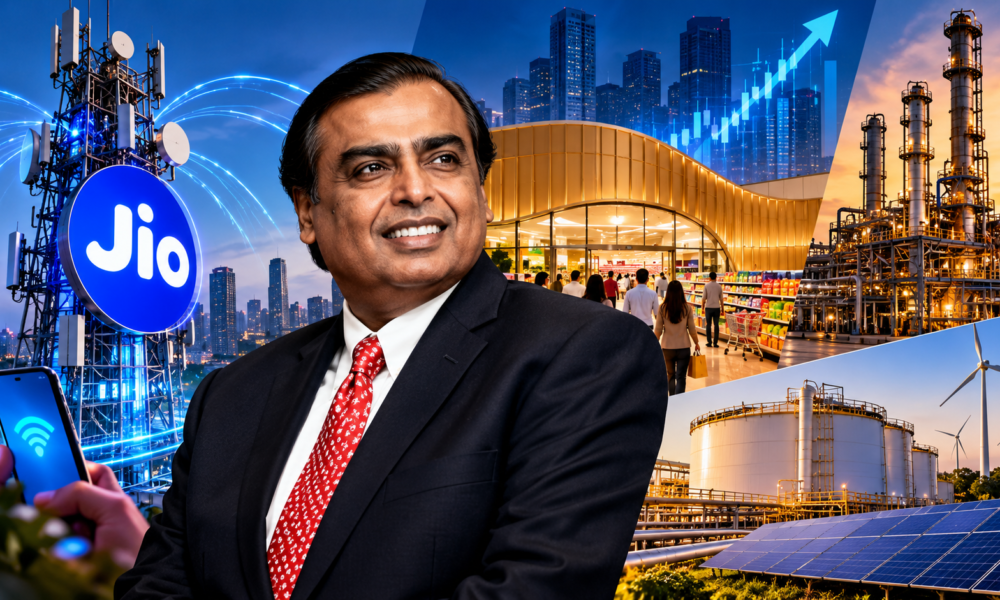
Reliance Industries Limited (RIL), led by Mukesh Ambani, occupies a distinctive position in India’s corporate landscape. Its businesses span telecommunications, digital services, retail, oil refining, petrochemicals and emerging energy technologies.
This diversified structure gives Reliance exposure to several sources of economic growth. Its digital operations benefit from rising connectivity and data consumption, its retail business serves India’s expanding consumer market, and its energy operations remain connected to domestic and international demand for fuels and industrial materials.
For investors, however, the central question is not simply how large Reliance has become. It is whether these businesses can sustain profitable growth while funding substantial investments in new infrastructure and technologies.
Jio: From Telecommunications to a Digital Platform
Reliance Jio has transformed India’s telecommunications market by expanding access to mobile data and competing aggressively on pricing. Its strategic importance extends beyond mobile connections to broadband, enterprise connectivity, digital applications and cloud-related services.
Reliance’s June-quarter FY2027 results reported more than 533 million Jio subscribers, including 285 million True5G subscribers. Jio Platforms reported record EBITDA of ₹20,865 crore for the quarter, up 15.1% year-on-year, according to the company’s reported results.
These figures illustrate the scale of the digital business. They also show why investors should track profitability alongside subscriber additions.
The next stage of growth depends on monetisation. Higher data usage does not automatically translate into proportionately higher profits. Tariff changes, average revenue per user, customer retention, network utilisation and the cost of maintaining infrastructure will influence financial performance.
Jio’s expansion into home broadband, enterprise services and digital platforms could create additional revenue opportunities. Yet the company must continue investing in network capacity and technology while competing with other telecom operators.
Retail: Capturing India’s Consumption Growth
Reliance Retail gives the group exposure to everyday consumer spending through grocery, electronics, fashion, lifestyle and other retail categories.
The long-term opportunity is supported by urbanisation, changing shopping habits, digital payments and the growth of organised retail. Reliance can also use its scale to develop omnichannel services, combining physical stores with online discovery, ordering and delivery.
However, retail growth should not be assessed through revenue alone. Store expansion requires spending on property, logistics, inventory, technology and employees. Rising sales can coexist with pressure on margins if operating costs increase faster than revenue.
Investors should therefore monitor comparable-store sales, retail margins, inventory efficiency, store productivity and the contribution of digital channels.
The competitive environment also matters. E-commerce platforms, specialist retailers, quick-commerce companies and established consumer brands are all competing for household spending.
Energy: A Large Business Facing a Long Transition
Reliance’s oil-to-chemicals operations remain an important part of the group’s financial structure. Refining and petrochemicals connect the company to global crude prices, fuel demand, industrial production and international product margins.
The June-quarter FY2027 results reported oil-to-chemicals EBITDA of ₹17,010 crore, up 17.2% year-on-year. That performance highlights the continuing importance of the conventional energy and materials business.
Yet the sector is cyclical. Crude prices, refinery margins, feedstock costs, geopolitical disruptions and global demand can change earnings considerably from one period to another.
Reliance is also pursuing new energy opportunities, including solar manufacturing, batteries and related clean-energy infrastructure. These investments could position the group to participate in India’s energy transition, but their commercial success depends on execution, technology, costs, policy support and customer demand.
The transition will require capital before all new businesses reach mature profitability. That makes investment discipline particularly important.
Capital Expenditure: Growth Today, Returns Tomorrow
Reliance’s strategy relies on substantial investment in networks, retail infrastructure, energy assets and new technologies.
Capital expenditure can strengthen future earnings when projects generate returns above their cost of capital. But investment is not automatically value-creating. Projects can face delays, cost overruns, slower demand or disappointing returns.
Investors should examine capital expenditure alongside operating cash flow, net debt, financing costs and the time required for new assets to become productive.
A key question is whether the cash generated by established businesses can fund new projects without placing excessive pressure on the balance sheet.
What Investors Should Watch
Five indicators are especially relevant when evaluating Reliance:
Jio: Subscriber trends, average revenue per user, EBITDA margins and broadband growth.
Retail: Revenue growth, operating margins, store productivity and inventory management.
Energy: Refining margins, petrochemical spreads and sensitivity to global commodity prices.
New energy: Project execution, manufacturing capacity, cost competitiveness and customer demand.
Group finances: Capital expenditure, operating cash flow, net debt and returns on invested capital.
Investors should also distinguish between consolidated financial performance and the valuation of individual business segments. Strong growth in one division does not guarantee that the entire group’s shares are attractively priced.
Conclusion
Reliance’s investment case rests on its ability to combine established cash-generating businesses with new sources of growth. Jio offers digital scale, retail provides exposure to consumption, and energy contributes industrial earnings and potential transition opportunities.
The decisive test is execution. If new investments generate sustainable cash flows and improve returns on capital, Reliance could strengthen its long-term growth profile. If investment rises faster than profitability, the group’s size alone may not be enough to satisfy investors.
For shareholders, monitoring the quality of earnings, capital allocation and balance-sheet discipline is as important as tracking headline revenue growth.
Disclaimer: This article is for informational and educational purposes only. It is not investment advice or a recommendation to buy or sell any security.




No Comment! Be the first one.