








What Is Private Equity? How Investment Firms Make Money From Unlisted Companies
When people discuss investing, the stock market is usually the first thing that comes to mind. Investors buy shares of listed companies, track market movements and attempt to generate returns through...


When people discuss investing, the stock market is usually the first thing that comes to mind.
Investors buy shares of listed companies, track market movements and attempt to generate returns through price appreciation or dividends.
However, a significant part of the investment industry operates outside public stock exchanges.
This is where private equity comes in.
Private equity refers to investments made in privately held companies or businesses through investment funds and other structures.
Rather than purchasing shares through a public exchange, private equity investors typically invest capital directly into businesses or acquire ownership stakes through private transactions.
The objective is to increase the value of these businesses and eventually generate returns through a sale, merger, public listing or another exit route.
What is private equity?
Private equity is a form of investment in which capital is deployed into companies that are not publicly traded, or into public companies that may subsequently become privately owned.
Private equity firms generally raise money from institutional investors and eligible high-net-worth investors.
These investors become limited partners in a fund, while the private equity firm or its investment manager oversees investment decisions.
The fund then uses its capital to purchase stakes in businesses.
These investments may involve established companies, growing businesses, restructuring opportunities or companies requiring additional capital.
How does private equity work?
The private equity investment process generally follows five stages.
- Raising capital
A private equity firm raises money from investors such as pension funds, insurance companies, institutional investors and eligible wealthy individuals.
- Finding businesses
The firm identifies companies that could benefit from additional capital, operational improvements or strategic changes.
- Investing in the company
The private equity fund acquires an ownership stake or purchases the business, depending on the transaction.
- Improving business performance
The investment firm may work on operational efficiency, management changes, expansion strategies, financial restructuring and acquisitions.
- Exiting the investment
The firm eventually seeks to sell its ownership stake, pursue an IPO or complete another transaction that allows the fund to realise its investment.
The process can take several years.
How do private equity firms make money?
Private equity firms typically generate returns through two broad channels.
Investment returns: The fund buys an ownership stake in a business and seeks to sell it at a higher valuation after improving its performance or benefiting from business growth.
Management fees and performance-related compensation: Private equity fund structures may include fees for managing the fund and performance-based compensation, subject to the fund’s agreements.
For example, imagine a private equity fund acquires a business valued at ₹500 crore.
Over several years, the firm supports business expansion, improves operating efficiency and strengthens profitability.
If the business is subsequently sold at ₹800 crore, the investment may generate a gain before accounting for transaction expenses, financing costs, taxes and fund-level fees.
This is a simplified illustration, not a guaranteed outcome.
Private equity firms typically generate returns through two broad channels.
Investment returns: The fund buys an ownership stake in a business and seeks to sell it at a higher valuation after improving its performance or benefiting from business growth.
Management fees and performance-related compensation: Private equity fund structures may include fees for managing the fund and performance-based compensation, subject to the fund’s agreements.
For example, imagine a private equity fund acquires a business valued at ₹500 crore.
Over several years, the firm supports business expansion, improves operating efficiency and strengthens profitability.
If the business is subsequently sold at ₹800 crore, the investment may generate a gain before accounting for transaction expenses, financing costs, taxes and fund-level fees.
This is a simplified illustration, not a guaranteed outcome.
Private equity vs public equity
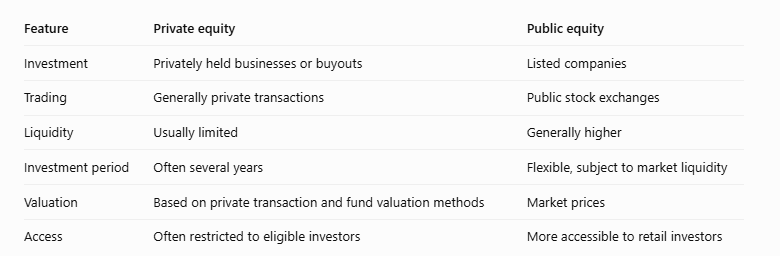
The two investment approaches differ considerably.
Feature Private equity Public equity
Investment Privately held businesses or buyouts Listed companies
Trading Generally private transactions Public stock exchanges
Liquidity Usually limited Generally higher
Investment period Often several years Flexible, subject to market liquidity
Valuation Based on private transaction and fund valuation methods Market prices
Access Often restricted to eligible investors More accessible to retail investors
Public equity allows investors to buy and sell shares through stock exchanges.
Private equity investments, by contrast, are typically long-term commitments with restrictions on withdrawals.
What are the different types of private equity investments?
Private equity is not limited to one investment strategy.
Venture capital: Investments in early-stage or high-growth businesses with significant expansion potential.
Growth equity: Capital provided to established companies looking to expand operations, enter new markets or strengthen their businesses.
Buyouts: Acquisition of controlling ownership in an existing company, sometimes using borrowed money.
Distressed investments: Capital deployed into financially troubled businesses that may require restructuring.
Each strategy carries different financial risks, investment horizons and potential returns.
What are the risks of private equity?
Private equity investments can involve substantial risks.
Limited liquidity: Investors may not be able to withdraw their capital whenever they want.
Long investment horizon: Capital may remain committed for several years.
Valuation uncertainty: Private companies do not have continuously available stock-market prices.
Business risk: A company may fail to achieve its growth objectives or may lose value.
Fees and expenses: Management fees and performance-related charges can affect investor returns.
The US Securities and Exchange Commission’s Investor.gov highlights illiquidity and fees as important considerations for private equity fund investors.
How does private equity work in India?
India has a growing alternative investment ecosystem.
Private equity investment activity is often structured through alternative investment funds, or AIFs, regulated by the Securities and Exchange Board of India.
Category II AIFs can include private equity and debt funds, subject to applicable regulatory requirements and fund structures.
These funds are not equivalent to ordinary retail mutual funds. Their eligibility criteria, minimum investment requirements, disclosures and liquidity arrangements differ.
Investors should review the applicable SEBI regulations and fund documents before committing capital.
Why does private equity matter to the economy?
Private equity can provide businesses with capital that may not otherwise be readily available through traditional funding channels.
It can support expansion, acquisitions, restructuring and professionalisation of business operations.
For entrepreneurs, it may provide access to strategic capital and experienced investors.
For the wider economy, successful investments can contribute to business expansion, employment and innovation.
However, private equity is not automatically beneficial in every transaction. Outcomes depend on investment decisions, financial discipline and the long-term performance of the companies involved.
Private equity therefore represents an important part of the financial ecosystem operating beyond public stock markets.
Disclaimer: This article is for educational purposes only and does not constitute investment advice.






No Comment! Be the first one.